The solitaire had a good run. One stone, one band, nothing to distract. For decades it was the default choice, the safe answer, the ring that came to mind the moment someone said the word engagement. Clean, classic, impossible to argue with.
That era is quietly ending.
A new generation of buyers has developed a far more sophisticated eye for ring design, and what they want looks nothing like the rings their mothers wore. They want sparkle that moves across the entire ring, not only the center stone. They want settings with presence, with detail, with intention. The solitaire still sells, but its stranglehold on the engagement ring market is loosening, and the styles replacing it are more interesting than anything the industry has seen in years.
The Numbers Tell the Story
This isn’t purely an aesthetic shift. It shows up in the data. According to The Knot’s 2024 Jewelry and Engagement Study, just over half of all engagement rings purchased that year featured a center stone with side stones or accent diamonds. That figure has climbed steadily, driven by two forces working in tandem: buyers are more visually educated than ever, and they have more access to distinctive designs than ever before.
Pinterest and Instagram deserve real credit here. A woman who spent six months saving ring photos before her partner proposed in 2024 arrived at that moment with an actual design vocabulary. She knows what a pavé band looks like versus a plain one. She knows what a seamless halo does for a center stone. She knows the difference between a ring that photographs beautifully and one that catches light beautifully in a restaurant at 8pm. That education has fundamentally changed what buyers ask for, and the industry has responded accordingly.
The Settings Redefining the Category
Several distinct styles are driving this shift, each with its own aesthetic logic and its own devoted following.
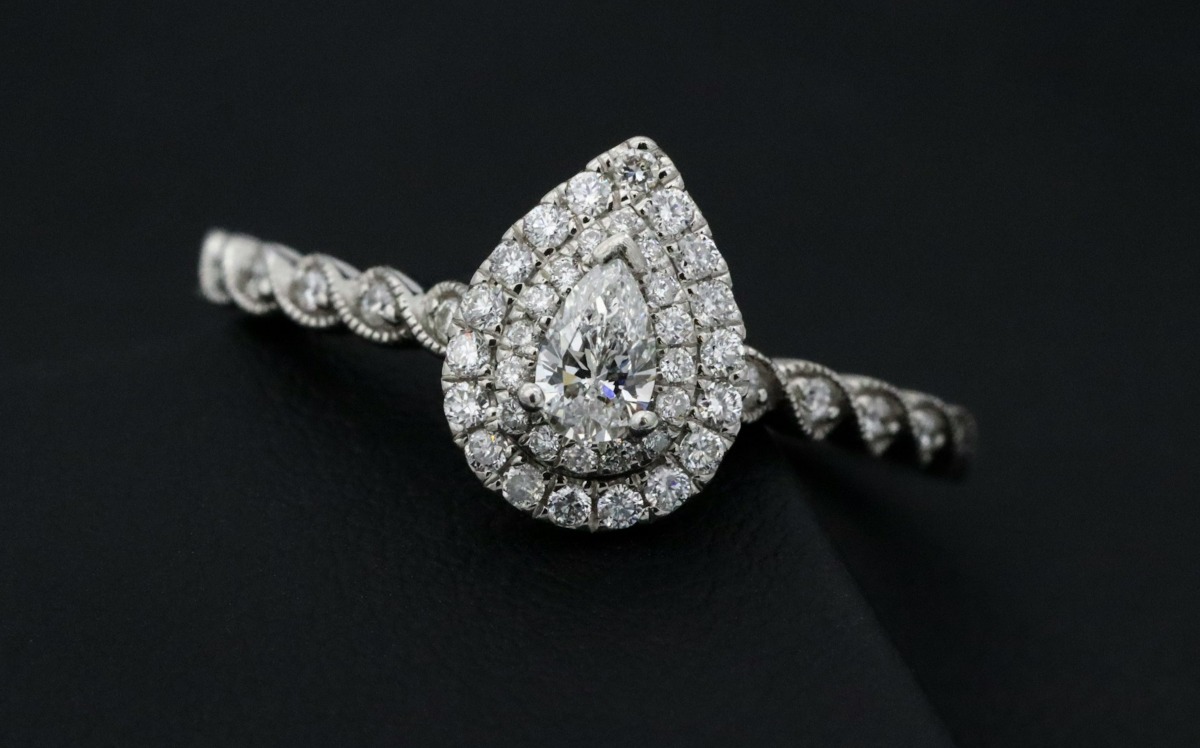
Micro pavé is perhaps the most quietly radical of them. The technique involves setting tiny diamonds so close together they are practically touching, creating an unbroken surface of light along the band and around the center stone. Done well, it transforms the entire ring into a single luminous object rather than a stone sitting on top of metal. The effect in person, particularly in natural light or candlelight, is genuinely striking. It’s the setting style most responsible for the idea that a ring should sparkle from across the room, not when held up to the light.
Halo settings have been popular for years, but the version gaining momentum now looks nothing like the classic round halo of the early 2010s. Elongated halos that follow the shape of oval or pear stones, hidden halos that add subtle brilliance without being visible from above, double-edge halos that frame the center stone with two concentric rings of diamonds: these are the variations drawing the most attention right now. The underlying appeal is the same across all of them. A well-executed halo makes the center stone appear larger, more prominent, and more brilliant than it would sitting alone on a band.
East-west settings represent a different kind of departure. Rather than the traditional north-south orientation, the stone sits horizontally across the finger, creating a long, architectural line that reads as distinctly modern. Elongated shapes like emerald cuts, ovals, and marquise diamonds are particularly well-suited to this treatment, and the result has an almost sculptural quality that stands apart from more conventional designs.
Multi-stone and toi-et-moi designs round out the trend with something more romantic in its logic. Two stones, often different shapes, set side by side to represent two people. The combination of an oval and a pear, or an emerald cut alongside a round brilliant, creates a ring that tells a story through its design. Celebrity visibility has accelerated the style’s popularity, but what keeps it relevant is the genuine meaning built into the concept.
Where Craftsmanship Becomes Impossible to Ignore
Here’s something worth understanding before falling in love with any of these styles: statement settings are unforgiving in a way that solitaires simply are not.
A single diamond on a plain band is a relatively contained design problem. The stone either looks good or it doesn’t, and the setting has limited opportunity to either help or hurt. Add a halo, a pavé band, or dozens of accent stones, and every decision made in the setting process becomes visible. The spacing between stones, the consistency of the stone color and quality throughout the ring, the precision with which the halo wraps the center diamond: all of it shows.
Stones that are spaced too widely create dark gaps that interrupt the flow of light across the ring. Accent diamonds that don’t match the center stone in color create a visible contrast that pulls the eye in the wrong direction. A halo with even a slight gap around the center stone makes that stone appear smaller rather than larger. These are not minor quibbles. They are the difference between a ring that looks extraordinary and one that looks ordinary despite costing the same amount.
This is why the craftsmanship conversation matters so much right now. A detailed guide to engagement ring settings, is worth reading before shopping, because understanding what separates excellent setting work from average setting work changes how you evaluate what you’re looking at. The buyers who know what to look for end up with rings that perform at the level they imagined. The ones who don’t often discover the gap between expectation and reality after the fact.
What to Look For When Shopping a Statement Ring
A few things worth examining closely, whether you’re shopping in a store or browsing online.
Look at the ring from multiple angles, not only the top-down view. A three-quarter angle reveals whether the halo sits flush against the center stone or has a gap. A profile view shows whether the pavé work continues consistently around the band or fades out on the sides where most photography stops.
Look at the stones in the setting as carefully as you look at the center stone. In a well-made ring, the accent diamonds should be white, bright, and consistent with each other. If the center stone is a cool, bright white and the surrounding stones look slightly warm or grey by comparison, the mismatch will be visible every day.
Ask about the spacing. Tight stone placement is a mark of precision setting work and it matters both visually and practically. Stones set with significant gaps between them collect residue over time, dulling the ring in ways that are difficult to clean out. The closer the stones sit to each other, the more seamlessly the ring sparkles and the better it holds up with regular wear.
Finally, prioritize finished ring photos over renderings whenever possible. Computer-generated imagery shows a design as a computer imagined it. What you want to see is the same design executed by a human hand, in metal, with real diamonds. Those two things can look quite different, and the gap between them is where setting quality lives.
The solitaire is not going anywhere. Its simplicity has a logic to it that will never fully go out of fashion, and for the right person with the right stone, nothing else makes sense. But the era of the ring as a complete design object, where the setting is as considered as the stone, where every diamond placed around the center contributes to something larger than itself, is very much here. For anyone with an eye for detail, that’s an exciting moment to be shopping for a ring.