On Dec. 17, 2010, in the bleak Tunisian town of Sidi Bouzid, a 26-year-old street vendor named Mohamed Bouazizi poured paint thinner on himself and lit a match. Little did he know was that he would ignite more than his wearied flesh. His pain (like labor) would give birth to a year like no other.
From Tunisia to Cairo then to Arab cities and towns across the Middle East, people mobilized against crime and corruption, poverty and injustice. Groups formed, in the streets, large and small, armed with nothing more than voices, banners and their I-phones. From Athens to Tel Aviv, Mexico and India, frustrated people demanded more of their government by offering more of themselves. Protesting was back… and the Social Network provided its fuel.
As Americans watched the scenes of brown people demonstrating across the Persian Gulf, they too longed to “take to the streets”. Americans of every age and varied backgrounds grew tired of bailouts and ponzi schemes. They were angered as conservative state governors stripped away collective bargaining rights and further denied access to the ballot box. They marveled as Middle Eastern young people cried for change and wondered if they had enough conviction to do the same.
Fifty years ago, no one would deny Americas resolve to protest injustice. From the 1950’s to the mid 1970s, Americans boldly protested racial and sexual discrimination, voting rights and ending the Vietnam War. These movements were energized by campaigns of civil resistance. Back then, marginalized Americans committed themselves to acts of nonviolent disobedience to produce crisis situations for state governments. They forced state houses to respond immediately to inequities or face a distressed populace that had the power to shut cities down. Their fierce determination ended wars and ushered in Civil Rights Laws and safer good paying jobs.
With this rich history, the act of protesting became the American birthright. Yet, it has been lost in the techno fueled economic expansion of the 1990s. Since the 90s, Americans of all races traded their marching shoes for quiet Metrorail commutes across urban epicenters to their service based jobs. Americans put down protest banners and picked up IPods to listen to soothing neo-soul sounds while drinking caffè lattes in air-conditioned Starbucks. Protesting was dead! In its place was the standard voting cycle. Every two years, Americans conveniently used the ballot box as the sole means of communicating their government of choice thus accepting a more structured and easily controlled means of social change.
During this season of American apathy, wealth was further concentrated to the top, while the working class paid the tab. The once responsive political system that produced the 1965 civil rights law and the historic Brown vs the Board of Education decision grew less concerned about constituents and instead developed rules to protect the few and enrich themselves. America had lost its way and average Americans were suffering because of it.
Back in 1990, Public Enemy’s ”Fight the Power” was a platinum-selling record. Yet today, is it just urban poetry or a call to arms? Is it possible for the once fabled organic energy of disenfranchised Americans to go from the streets to the boardroom? Could people still “fight the power”? Or has the decadence of Western 20th century success muzzled America’s voice and cooled its fire?
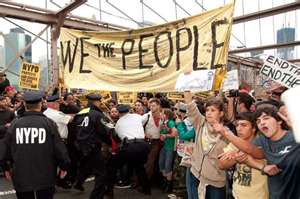
Today, the answer is clear. Americans still possess the spontaneous confidence to publically confront the powerful. On September 17, 2011 in Zuccotti Park, located in New York City’s Wall Street financial district a group of Canadian activists protested against economic inequality and crony-capitalism. Their selfless act was later joined by millions of Americans demanding political and economic change. This movement, called “Occupy Wall street”, chorales’ around the theme that the wealthiest 1% has all the advantages.
Each day, these regular Americans are proving that a fire still burns to fight for a fairer social contract.
This is our birthright.
This is who we are.
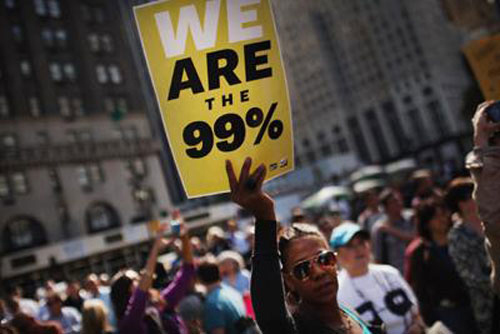
We are the 99%.
On Dec. 17, 2010, in the bleak Tunisian town of Sidi Bouzid, a 26-year-old street vendor named Mohamed Bouazizi poured paint thinner on himself and lit a match. Little did he know was that he would ignite more than his wearied flesh. His pain (like labor) would give birth to a year like no other.
From Tunisia to Cairo then to Arab cities and towns across the Middle East, people mobilized against crime and corruption, poverty and injustice. Groups formed, in the streets, large and small, armed with nothing more than voices, banners and their I-phones. From Athens to Tel Aviv, Mexico and India, frustrated people demanded more of their government by offering more of themselves. Protesting was back… and the Social Network provided its fuel.
As Americans watched the scenes of brown people demonstrating across the Persian Gulf, they too longed to “take to the streets”. Americans of every age and varied backgrounds grew tired of bailouts and ponzi schemes. They were angered as conservative state governors stripped away collective bargaining rights and further denied access to the ballot box. They marveled as Middle Eastern young people cried for change and wondered if they had enough conviction to do the same. The ideas of protests for social change in America begun arising.
Fifty years ago, no one would deny Americas resolve to protest injustice. From the 1950’s to the mid 1970s, Americans boldly protested racial and sexual discrimination, voting rights and ending the Vietnam War. These movements were energized by campaigns of civil resistance. Back then, marginalized Americans committed themselves to acts of nonviolent disobedience to produce crisis situations for state governments. They forced state houses to respond immediately to inequities or face a distressed populace that had the power to shut cities down. Their fierce determination ended wars and ushered in Civil Rights Laws and safer good paying jobs.
With this rich history, the act of protesting became the American birthright. Yet, it has been lost in the techno fueled economic expansion of the 1990s. Since the 90s, Americans of all races traded their marching shoes for quiet Metrorail commutes across urban epicenters to their service based jobs. Americans put down protest banners and picked up IPods to listen to soothing neo-soul sounds while drinking caffè lattes in air-conditioned Starbucks. Protesting was dead! In its place was the standard voting cycle. Every two years, Americans conveniently used the ballot box as the sole means of communicating their government of choice thus accepting a more structured and easily controlled means of social change.
During this season of American apathy, wealth was further concentrated to the top, while the working class paid the tab. The once responsive political system that produced the 1965 civil rights law and the historic Brown vs the Board of Education decision grew less concerned about constituents and instead developed rules to protect the few and enrich themselves. America had lost its way and average Americans were suffering because of it.
Back in 1990, Public Enemy’s ”Fight the Power” was a platinum-selling record. Yet today, is it just urban poetry or a call to arms? Is it possible for the once fabled organic energy of disenfranchised Americans to go from the streets to the boardroom? Could people still “fight the power”? Or has the decadence of Western 20th century success muzzled America’s voice and cooled its fire?
Today, the answer is clear. Americans still possess the spontaneous confidence to publicly confront the powerful. On September 17, 2011 in Zuccotti Park, located in New York City’s Wall Street financial district a group of Canadian activists protested against economic inequality and crony-capitalism. Their selfless act was later joined by millions of Americans demanding political and economic change. This movement, called “Occupy Wall street”, chorales’ around the theme that the wealthiest 1% has all the advantages. Each day, these regular Americans are proving that a fire still burns to fight for a fairer social contract with protests for social change in America.
This is our birthright.
This is who we are.
We are the 99%.
Advertisement
Readers May Also Like:

NLE Choppa Leads Peaceful Protest in Honor of Tyre Nichols
Advertisement
Anti-Trump Protest To Happen at Tonight’s College Football Playoff Game in ATL
Advertisement
Beyond The NFL Protest: Where Do We Go From Here?
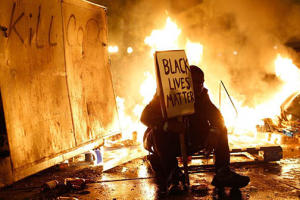
Black Lives Matter Images – Some of The Powerful Images Sparking The Protest
Advertisement