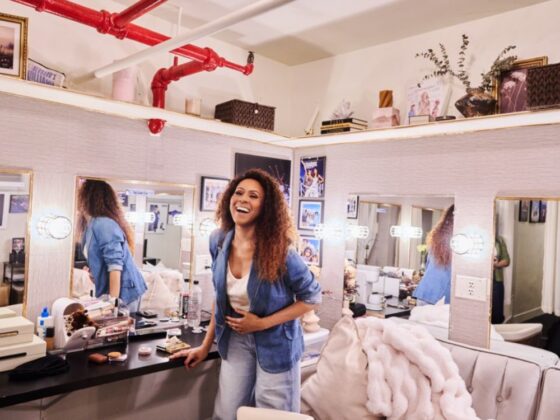
Lifetime has a way of dressing chaos up real pretty—marriage, family, trust… all of it looking steady right up until it isn’t. And in their latest film, Don’t Trust the Girls Upstairs, that surface starts to fracture in real time, where grief, suspicion, and silence all start breathing in the same space.
At the center is Remy Ma as Ashley Preston—leaning into a different kind of intensity. Not the explosive force of a verse, but controlled pressure, where every pause and glance starts to carry its own weight.
And that shift hits deeper when you trace the full picture.
Born Reminisce Kioni Smith in the Bronx, Remy Ma came up through Hip-Hop’s most competitive lanes—discovered through Big Pun and breaking through with Fat Joe’s Terror Squad. “Lean Back” became a cultural moment, not just a hit, followed by solo staples like “Conceited,” and a later resurgence with “All The Way Up,” reminding everyone her voice never left the landscape.
Her story has never been linear—it’s been interrupted, tested, and rebuilt. A prison sentence paused her momentum at its peak, but her return wasn’t about chasing relevance—it was about reclaiming space in a culture she helped shape.
Beyond music, she built infrastructure. Chrome 23 created a platform for women in battle rap to be seen, booked, and respected in a space where visibility has never been guaranteed. Reality TV gave audiences a more unfiltered look at her world, but music has always remained the core frequency.
And now she’s back on the airwaves again with “Ever Since U Left Me (Big Bronx Remix – Knicks Edition),” with French Montana and Max B—a reminder that her sound still moves through New York with that same weight and identity.
Now she steps into Lifetime’s world of controlled chaos—where nothing is as stable as it looks, and every relationship carries something unspoken underneath it.
And in this role, she doesn’t just enter the story.
She sharpens it.
Parlé Mag: Going from recording records that shook clubs worldwide to carrying psychological tension on screen — what kind of different vulnerability does acting pull out of you that music never had to?
Remy Ma: Acting is more about tapping into the character and becoming the character, not yourself. With my music, I’ve always tried to make sure that I am still Remy at all times, you know? A lot of artists have to put on a persona—“Let me turn into little so-and-so or big whoever”—and I never wanted to do that.
When it comes to acting, you literally have to not be yourself. You want to be anything but yourself. I found out I actually have a strong New York accent—who knew? I didn’t. One of my lines in this movie is “I have to get a coffee,” and I had to work on enunciating my words because I want to say “caw-fee.”
But I enjoy becoming someone else. Memorizing and knowing the part—that’s second nature.

Parlé Mag: Lifetime thrillers carry a certain emotional pressure—secrets, betrayal, trauma, paranoia. What was it about Ashley Preston that made you say, “Yeah… I know this woman”?
Remy Ma: Lifetime made sure they checked all the boxes when it came to my character. But what I liked about Ashley is that she still had grit. She just wants to get it done, and that’s kind of a Remy thing.
I would probably like to play a character that’s different from me, but when you have one that shares similar traits, it’s easier to tap into. So I just had to get into the right mode to bring her to life.
Parlé Mag: You’ve spent years controlling narratives through lyrics. Acting is different because silence, facial expressions, and timing have to speak too. Was that adjustment natural or frustrating at first?
Remy Ma: Absolutely. With music, you’re telling stories through your own words. I’m writing it, so I know exactly how I want the story to sound, how I want to say something, and what comes next.
With acting, it’s different. You have a script, directors, and a bigger story you’re helping tell. Sometimes they let you tweak a line if it feels more natural, but other times they say, “No, we need that exact word,” because it ties into the story.
In the beginning, I’d say, “That doesn’t even make sense. I wouldn’t say that.” Same thing with wardrobe—I’d look at outfits and think, “This is horrible.” But I had to remind myself it’s not Remy’s outfit—it’s the character’s outfit.
There were definitely times I’d point things out and say, “This doesn’t feel natural,” and they’d adjust it. But that’s the transition—when you’re used to being the writer and having full control of the story.
I remember one movie I did with Tami Roman—I had on these high-water pants and was complaining the whole time. I was making sure I packed extra Vaseline because I knew my ankles were going to be showing. But that’s acting. You have to separate yourself from the character and trust the process.
Parlé Mag: “W.Y.F.L.” had the internet dissecting every line. Do you ever laugh watching people try to decode your bars in real time like courtroom evidence?
Remy Ma: Seriously, I wake up every day with the goal of laughing as many times as I can. People think I’m a mean girl, but I’m actually a comedian.
I don’t even think I’m funny most of the time—I’ll be dead serious—but my friends think I’m hilarious. So yeah, I definitely laugh at internet reactions.
Sometimes people read way more into things than I do. I remember someone breaking down a line from “W.Y.F.L.” and explaining all these meanings behind it. That wasn’t even what I meant—but it sounded fire. I said, “Yeah, that’s exactly what I meant.”
Sometimes the internet comes up with interpretations that are better than the original idea. They’re right—the internet really is undefeated.
Parlé Mag: How important is honesty to your artistry at this stage of your life?
Remy Ma: Being authentic has been important to me at every stage of my life—not just with music. I’ve seen so many people I met before they became big completely change once they got success. I never wanted that to be me.
I don’t want to be the person who changes just because of money. I’ve been doing this for over 20 years and have managed to move through all the different social media eras—from Myspace to Instagram.
It’s definitely not easy, but I think I’ve done pretty well.
Parlé Mag: Hip-Hop still doesn’t fully give women grace to evolve publicly. You’ve faced scrutiny, motherhood, legal battles, marriage in the spotlight, and comeback pressure—all while remaining lyrically dangerous. How do you protect your peace now?
Remy Ma: You have to have thick skin. You have to know who you are before you enter this industry. If you’re weak-minded or too sensitive, you’ll become someone you never intended to be because you’ll change every time public opinion shifts.
As women, we definitely get treated differently. A man can be in his 40s or 50s and still be celebrated. But rap is one of those art forms where you actually get better with time. Your vocabulary expands, your perspective grows, and you find new ways to play with words.
Hip-Hop is still young, and people are quick to discard artists once they reach a certain age. But in other genres, longevity is celebrated. Legendary artists still sell out arenas.
I’ve lost so many people from my era to violence, prison, cancer, and addiction. Some never got to see the success I’ve been fortunate enough to experience. So if you’re lucky enough to grow older, that’s something to be grateful for.
At the end of the day, you can’t let the industry define you. Especially now, when everybody with a phone has an opinion. If you don’t know who you are, those opinions will make you question yourself every day.
Parlé Mag: “Lean Back” still moves crowds like time froze in 2004. When that beat drops unexpectedly today, what’s the first memory that hits you?
Remy Ma: My MTV Awards performance. That’s probably when I knew, “OK, this record is out of here.”
I’ve had records, but “Lean Back” was something different. I remember watching Bruce Willis, Queen Latifah, all these people dancing to my song.
Even now, like at the Knicks parade, I’m seeing the mayor and the players holding the trophy and singing it. It’s a wonderful thing.
Parlé Mag: What makes you proud and what still disappoints you about today’s women in Hip-Hop?
Remy Ma: What makes me proud is the collaborations—seeing Latto and Cardi, GloRilla and Megan, Ice Spice and Latto. Seeing women come together and actually make records together.
In my time, it was harder to get two successful female rappers on one track because everyone was competing to be the only one. That never made sense to me.
What I don’t love is the lack of variety in subject matter. A lot of content can feel similar. That’s something I focused on with my upcoming sophomore album—I wanted to touch different topics.
Women go through so much. We’re mothers, providers, entrepreneurs, wives, daughters. Life isn’t one-dimensional, so music shouldn’t be either.
At the same time, I love seeing everybody win. Women are more visible in hip-hop than ever. If you ask someone to name five rappers, two or three are likely women now. That’s real progress.

Parlé Mag: With the Remy Network expanding and acting opportunities growing, are you intentionally building legacy outside music?
Remy Ma: Absolutely. Music is a stepping stone. It opens doors into other industries—acting, entrepreneurship, investing, media.
Look at Queen Latifah, LL Cool J, Ludacris, Will Smith. Some people almost forget they started as rappers.
My goal has always been to use music as the vehicle, then expand beyond it. Music got me in the room—but I want people to support everything I build beyond that.
As a woman, you have to think long-term. There needs to be a Plan B, C, and D. I’ve built a lifestyle for myself and my family, so I have to think about sustaining that beyond touring and recording.
That’s why so many artists are moving into podcasts, TV, film, and business. They’re building platforms that last.
What I don’t see enough of are women building those platforms at scale. That’s something I want to change.
Parlé Mag: After all the headlines, success, setbacks, and reinventions—what do you hope people finally understand about Remy Ma?
Remy Ma: I’m a human being.
Sometimes people forget there’s a real person behind the headlines. I have feelings, emotions, a family, people I love and people who love me.
Being in the public eye isn’t easy. If I wasn’t mentally strong, some of it could break a person.
Even positive attention can feel intrusive sometimes. People assume it’s only negative stories that affect you, but sometimes you just want parts of your life to stay private.
I’ve even called blogs and asked them to take things down—not because they were negative, but because I didn’t want everything shared.
At the end of the day, I just hope people understand that behind everything they see, I’m still a person growing, learning, making mistakes, and trying like everybody else.
Stay Connected with Rema Ma
Instagram: @remyma
Streaming Platform: The Remy Network
Movie Trailer
YouTube: Don’t Trust the Girls Upstairs