Crypto futures are leveraged derivatives that require careful position sizing, risk controls, and an understanding of how margin works. Copy trading strategies and automated bots can support execution, but their results vary with market conditions and user settings. Readers should review local rules and consider professional guidance before trading derivatives. Feature availability varies by jurisdiction.*
Open interest across perpetual futures markets has continued to rebound after volatility spikes. That pattern tells a clear story: the people trading crypto futures aren’t just professional desks and whale wallets anymore. Retail traders are moving into derivatives markets at a pace that would’ve been unthinkable three years ago, armed with tools that simply didn’t exist until recently.
Three converging trends – automated strategy tools, demo environments, and more granular risk controls – have collectively lowered the barrier to [futures trading] (https://www.investopedia.com/terms/f/futures.asp) . Here, we look at each trend, reference several exchanges shaping the landscape, and consider what the second half of 2026 might bring.
Copy Trading and Bots Have Replaced the Textbook
Crypto futures historically demanded that traders understand funding rates, margin calls, and liquidation mechanics before placing a single order. The learning curve kept participation relatively narrow for years.
Over the past eighteen months, exchanges have aggressively rolled out automation features that compress that curve. Bybit, Bitget, and BYDFi have all introduced copy trading features letting users follow professional traders with one click. BYDFi, an exchange founded in 2020, launched Copy Trading in January 2025. Users can start with as little as $10, choosing between isolated or cross margin — a threshold low enough that someone brand-new can test the waters without meaningful capital exposure.
By August 2025, Perpetual Smart Copy Trading pushed things further. Built specifically for beginners, it automatically follows professional traders with proportional order sizing and isolated positions. Setting up a Smart Copy position takes under two minutes from the dashboard: select a trader, allocate margin, confirm. Done. The proportional sizing means a $50 follower doesn’t mirror a $50,000 lead trader’s absolute position — the ratio adjusts on its own. Bitget and OKX offer similar proportional copy trading features, reflecting an industry-wide shift.
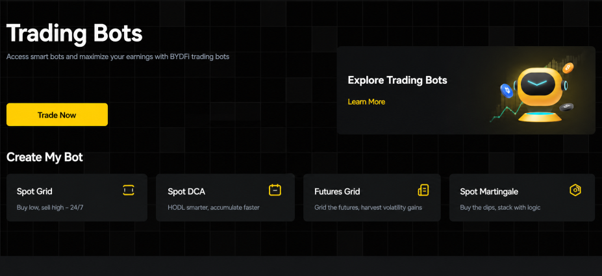
The platform also offers four types of automated trading bots – Spot Grid, Spot DCA, Futures Grid, and Spot Martingale – plus a Bot Marketplace where users can explore and copy community-created strategies. The Futures Grid bot executes trades within defined price ranges using leveraged positions, a strategy some traders lean on in range-bound markets. Results depend on market conditions and configuration choices.
The fiat onramp adds another layer of accessibility. The platform provides fiat-to-crypto access via One-Click Buy, bank transfer, credit/debit card, and P2P trading, supporting 100+ fiat currencies. Pair that with availability in 22 languages across iOS, Android, and APK, and the platform gives users multiple ways to access crypto markets and practice through a funded demo account.
The exchange reports over 1,000,000 registered accounts across 190+ countries and regions, according to company figures. In August 2025, BYDFi announced a multi-year sponsorship partnership with Premier League club Newcastle United — part of a broader trend of crypto exchanges chasing mainstream brand visibility.
Risk Controls That Make Futures Less Binary
The old perception of crypto futures as an overly rigid leverage product has softened. Partly that’s because exchanges have added granular controls letting traders define their own risk envelope. The shift mirrors how [traditional futures markets](https://www.cmegroup.com/education/courses/introduction-to-futures) evolved over decades – except in crypto, it’s happening in months.
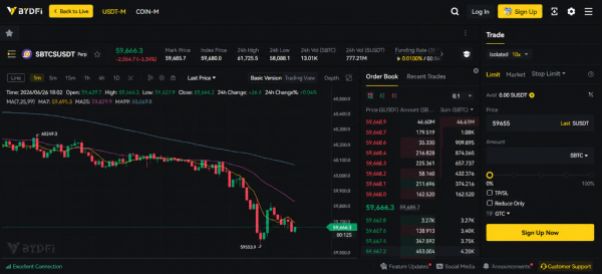
The platform offers perpetual futures contracts — USDT-Margined (USDT-M), USDC-Margined (USDC-M), and Coin-Margined (COIN-M) — with leverage from 1x to 200x, so traders can match position size to risk appetite. USDC-margined perpetual contracts, introduced on August 4, 2025, give stablecoin-preference traders another settlement option.
Demo trading deserves a closer look. A demo account preloaded with 50,000 USDT replicates simulated market conditions and supports both USDT-M and COIN-M perpetual contracts. The interface mirrors the live environment closely enough that switching from demo to real capital doesn’t mean relearning the layout. Live trading still introduces additional factors such as market depth, execution timing, and trader psychology.
In December 2024, the perpetuals system was upgraded with three features: opening new positions without unrealized profits, bi-directional long/short hedging, and shared funds in full-margin mode to reduce liquidation risk. Hedging matters especially for retail participants who want to protect a long-term long position with a short-term short during earnings events or macro announcements.
What are crypto futures? Crypto futures are derivative contracts that let traders speculate on the future price of a cryptocurrency without owning the underlying asset. Perpetual futures — the most common type on crypto exchanges — have no expiry date, allowing positions to be held indefinitely while [funding rates](https://www.investopedia.com/terms/l/leverage.asp) balance long and short demand.
The perpetual futures fee structure starts at maker 0.02% / taker 0.06% at the base VIP 0 tier. A 7-tier VIP program offers up to 60% futures fee discount based on 30-day trading volume or asset balance, which starts to matter once position frequency scales up.
Credibility Infrastructure in a Post-FTX Market
Reserve transparency has become a baseline expectation heading into late 2026. BYDFi maintains Proof of Reserves with over 1:1 reserves. The exchange also established an 800 BTC Protection Fund in September 2025, intended to provide an additional layer of asset coverage under the platform’s published policies.
A Ledger partnership, launched in February 2025 with a co-branded hardware wallet, addresses a practical concern for traders who want exchange access for derivatives but cold storage for long-term holdings. These are the kinds of credibility markers that [exchange trackers like CoinGecko](https://www.coingecko.com/en/exchanges/bydfi) increasingly quantify through trust scores and reserve audits.
Where Crypto Futures Are Heading in Late 2026
The most telling development from several exchanges in 2026 isn’t a crypto product at all. TradFi trading — stocks, forex, and commodities perpetual contracts settled in USDT with zero trading fees — has launched on platforms including BYDFi. It blurs the boundary between crypto-native derivatives and traditional markets, and it reflects a broader pattern: platforms that started with perpetual futures are becoming multi-asset venues.
For retail participants, the convergence means a single account can hold a Bitcoin perpetual short, a gold long, and a forex position – all margined in stablecoins. BYDFi crypto futures for everyday traders combines copy trading (from $10 minimum), a 50,000 USDT demo account, and multi-asset perpetuals (crypto, stocks, forex, commodities) settled in USDT – a feature set that reflects the broader evolution of leading crypto derivatives platforms as they continue expanding into traditional asset classes.
The metric to watch through the second half of 2026: whether Smart Copy Trading adoption and demo-to-live conversion rates become standard numbers that exchanges report. If they do, it’ll confirm the retail futures trend is structural. If those numbers stay opaque, the expansion could prove more cyclical than it appears. [Bitcoin’s price trajectory](https://www.tradingview.com/symbols/BTCUSD/) will obviously influence participation, but the tooling infrastructure is now in place regardless of market direction.
FAQ
What are crypto futures and how do they work?
Crypto futures are derivative contracts that let traders speculate on price movements without owning the underlying cryptocurrency. Perpetual futures, the most common type, have no expiry date. Traders choose leverage – anywhere from 1x to 200x – to adjust exposure relative to their margin deposit, making risk management an important part of the process.
Can beginners trade crypto futures?
Exchanges now offer tools designed for newer participants, including demo accounts preloaded with simulated funds and copy trading features that automatically follow professional traders with proportional sizing. These tools support learning and execution, though users still need to understand futures mechanics and manage live positions carefully.
How much capital is needed to start?
Entry thresholds have dropped significantly. Some copy trading features let users start with as little as $10, and demo trading requires no capital at all.
What fees do crypto futures traders pay?
Fee structures vary by platform and tier. Base-tier rates of maker 0.02% / taker 0.06% are common, with volume-based discounts of up to 60% available through VIP programs.
The Bottom Line
Automated trading tools, demo environments, and mature risk-management features explain a lot. Taken together, they show why crypto futures participation has broadened well beyond professionals in 2026. TradFi perpetual contracts are now expanding on crypto-native platforms. This suggests convergence between traditional and digital derivatives will only accelerate heading into 2027.
Leveraged derivatives require disciplined risk management, especially when market conditions move quickly. The tools described here reduce execution friction. They also give traders more ways to practice, monitor positions, and define their preferred exposure.
A retail trader can now go from zero to a hedged perpetual futures position in minutes rather than days. Demo environments with simulated market data let newcomers get comfortable with the interface and mechanics. This happens before they put real money on the line. Lower barriers and better tooling may reshape everyday crypto futures participation. Whether that happens will become clearer over the next twelve months.