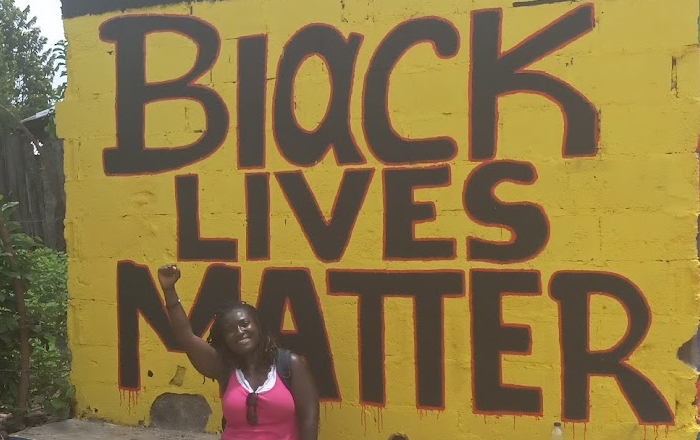
“Do you know you are Black like us?” the eight-year-old boy asked.
I was volunteering at a school in Nairobi, Kenya. The children gathered around me almost immediately, whispering. They were deeply curious about me. I was one of the only Black American volunteers there, maybe the first one they had ever seen.
He looked at me carefully, like he was trying to make sense of what he was seeing.
“Do you know you are Black like us?” he asked again.
I laughed, surprised by the question. “Yes,” I said. “Of course I know.”
But before I could say anything else, he kept going. “Do you know Michelle Obama?”
“Are you related to Barack Obama?” a girl in the back shouted.
I smiled. “I’m not related to Barack Obama,” I told them. “But he’s actually half Kenyan, so you’re probably more likely to be related to him than I am.”
This was quite an amusing line of interrogation. I played along while they tried to stump me, or perhaps just tried to wrap their minds around a Black volunteer from the United States. My Blackness made me familiar. My Americanness made me foreign.
In a way, that exchange held so much. Somewhere in between those two things was where I would spend the next two decades of travel. I have been to fifty countries and over two hundred cities on six continents. My Blackness went everywhere with me. But what it meant when I arrived was always different.
Africa: Sister, Insider, or Outsider?
In Senegal, they call it Teranga. Hospitality is so embedded in the culture that it has its own name. I had been there three times, and by the third, it felt like home. Walking through my friend’s neighborhood, I saw faces light up when they recognized me. The peanut vendor came out from behind her cart and hugged me. The restaurant owner greeted me with a warm smile. “You have returned,” he said. The coffee shop barista called me sister like it was my name.
I was familiar, a neighbor, a sister, a friend, but I was also American. It lived in my accent, in the ways I moved, my hair, my clothes. I did not know much French or Wolof, but I was always welcome. I was both an insider and an outsider at the swsaawqame time.
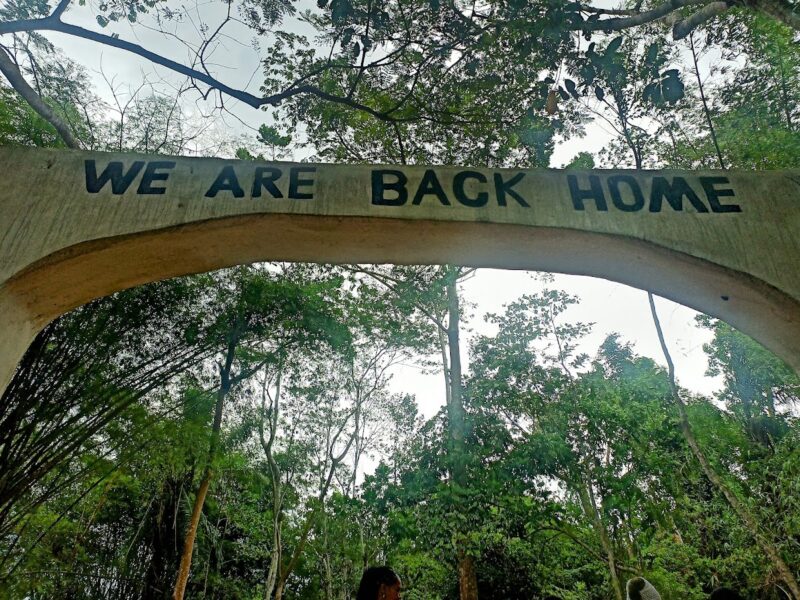
In Ghana, it went deeper. At the place of the last bath, where enslaved Africans were brought to bathe in the river before being taken to dungeons to await ships, our guide Kwame asked each of us what day we were born. He gave us our Ghanaian names. He reminded us that when our ancestors were stolen, a piece of those who remained was taken too. We were both incomplete, missing something we couldn’t fully name, but trying to reclaim it that day. We went down into the water singing the spiritual ‘Wade in Water,’ and when we came back up, the sign above our heads read: We Are Back Home. The ritual felt complete.
And then I stepped off the bus to enter Elmina Castle and vendors aggressively tried to sell me souvenirs, and I remembered I was a tourist. The connection was real, but so was the distance.
In South Africa, I felt conflicted. I volunteered in a coloured township outside of Cape Town, and when I went to an open mic and listened to a coloured woman talk about her identity, I remember thinking that in the United States, she would simply have been Black. The categories were more complicated. I was uncomfortable, stuck somewhere in between.
On my birthday, I treated myself to dinner on the Garden Route, a long, beautiful stretch of coastline where wealthy South Africans and tourists vacation. I was the only Black person in the restaurant. The waiter, a Black man, came to my table and asked where I was from. I sat with that question for a moment. Was it my dress? My locs? Or was it simply that a Black South African eating in a fancy restaurant didn’t quite fit the picture he’d been handed? I was perplexed.
A mile or so up the road from the white tablecloth restaurants and a fancy cruise I treated myself to, I visited a township. Women lined up with water buckets at a water spigot. A little boy without shoes took my hand and led me around. The juxtaposition made my head spin.
I sat between those two worlds my entire time there. My color put me in one place. My Americanness, my money, gave me access to a privilege that made me cringe. The racial hierarchy was layered and unresolved. I was in between worlds whether I wanted to be or not.
Africa, for me, was always a question: Am I a tourist, or am I a sister? The answer was always both.
The Americas: Recognition and Resistance Across Oceans
I found a Black women’s walking group in Mexico City. Fifteen of us, meeting on a Saturday morning in Chapultepec Park, doing what Black women do, laughing loud along the route, talking about our dreams, where we were from and what we were going to do next. I had lunch and dinner with Black women, digital nomads and expats, and went to a jam session at someone’s house. I found a piece of home in a city of 23 million people where most folks did not look like me.
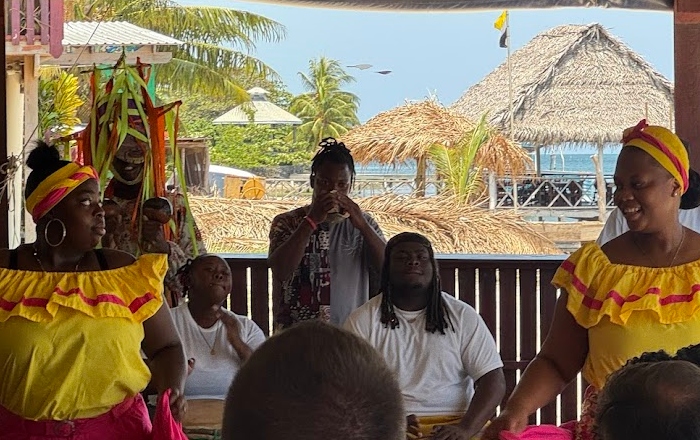
Along the Caribbean coast of Central America, Livingston in Guatemala, Roatán in Honduras, I heard reggae drifting through the air and ate Garifuna soup: coconut, curry, seafood, slow-cooked and layered like history in a bowl. The mix of coastal culture and Caribbean vibes felt like something I’d grown up around in New York. Food was memory. Flavors had moved across oceans the way people did, changed by the crossing, but still recognizable.
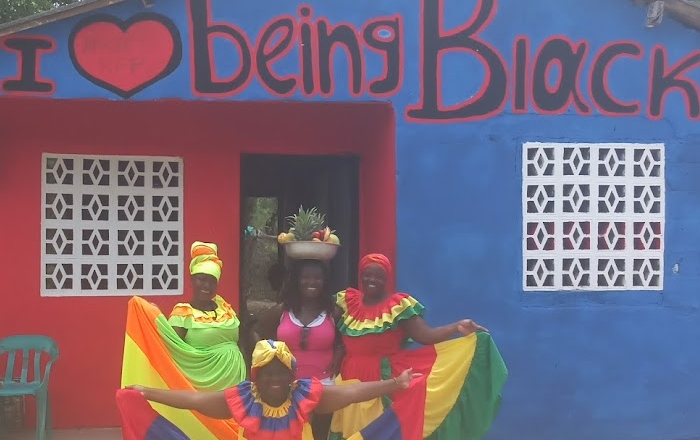
In Colombia, Cartagena was full of Black people and history, including San Basilio de Palenque, the first free town in the Americas. There was resistance, self-determination, music, rhythm, color. It was all there moving through the streets, and I moved with it. In Cali, I connected with an Afro-Colombian tour guide passionate about Black history. In Medellín, I again found a group of Black expat women and nomads, resourceful, warm, my people. And woven through all of it was a creativity I kept encountering across the diaspora. The self-emancipated towns of Central and South America, people who ran toward freedom and built cultures, cuisines and spiritualities.
I witnessed West African spiritual practices that crossed the Atlantic, morphed, synchronized, and survived. Candomblé Baianas dressed in white on street corners in Brazil were keepers of tradition. A Santería Babalawo blessed me as I kneeled at an Orisha altar in Cuba. These spiritual traditions helped people stay alive. That resilience was its own kind of art, made by and for us. This spirituality of resistance resonated with me.
Peru, however, was tough. I volunteered for three weeks at a school in the mountains above Cusco. When I walked in on that first day, the schoolyard went quiet. Then slowly, kids started coming, twenty, maybe thirty of them crowding the bleachers where I sat. They pulled my hair and pinched my skin. I was a spectacle the entire three weeks. I was miserable.
But one day inside the classroom, a little boy looked up at me while I was teaching the alphabet and asked, “Is it hot in your country?”
“A few months out of the year,” I said. “Why do you ask?”
“Is that how your skin got that way?”
I told him no. I was born like this. I put his hand next to mine and let him look. He rubbed it gently.
“Just like yours,” I said. “Just a different color.”
He nodded, satisfied, and we went back to the alphabet. I assumed most of the kids there had likely never seen a Black person before. The experience was hard, but moments like that were a small balm for my racial wounds.
Europe: Beauty and Empire
Advertisement
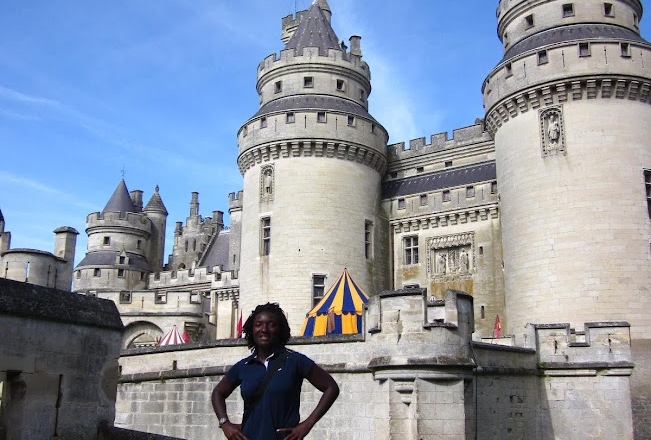
I’ve visited twelve countries in Europe and found something to love in each place. The beauty is real and the history is everywhere. But I was also aware of whose history it was. I was traipsing through the lands of the colonizers while carrying the living aftermath of colonization in my own DNA.
At the British Museum, I marveled at the history of the world laid out in 100 objects, only to later realize how many of those artifacts were entangled in empire, conquest, and contested ownership. There was something unsettling underneath all that beauty.
During that same trip, I visited an exhibit at The Wellcome Collection called Skin. As I stood looking at the section on race, a handsome Nigerian man and I sparked up a conversation. How ironic that we were in Britain, visiting an exhibit on skin. Our skin was connected to a continent that was conquered. Both of us, me through enslavement, him through colonialism, were impacted by this reality in different ways. Like many African Americans, nearly a third of my ancestry traces back to Nigeria. In some distant way, we may have descended from the same place, separated by centuries.
As we walked through the exhibit, we talked about how Christianity looked in Nigeria compared to the Black Church in the United States. We were also living inside spiritual traditions shaped by colonization. That history, too, was part of why we spoke the same language.
Oddly enough, I felt most at home in London. Multicultural, layered, nobody particularly surprised to see a Black person. It felt like a mini New York. I didn’t experience any hostility, just observed the distance between their history and mine, oceans wide. Or maybe I was just on the opposite side.
Asia: Spectacle, Curiosity, and Shared Humanity
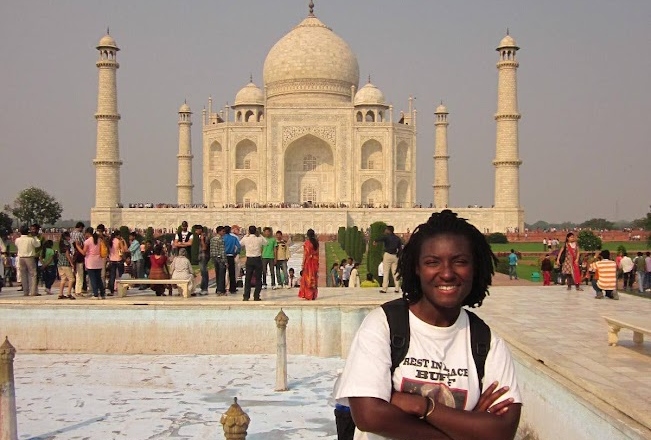
At the Taj Mahal, I stood at the edge of the reflecting pool thinking about The Emperor Shah Jahan’s love and loss, while people around me held their phones low by their hips, angled up, trying to be subtle about photographing me. I smiled. Likewise, at Gandhi’s eternal flame, it happened again. In a village outside New Delhi, a young girl came so close our noses touched. I was a curiosity again, something to be stared at and photographed.
But in the quiet moments, volunteering at a children’s home, Sanya and the other children called me didi, meaning sister. She marveled at my locs.
“Is it real?” she asked. “Your hair, didi, is it real?”
“Yes,” I replied.
“How did you get it like that?”
I took a loc and showed her how I palm rolled it.
“Can you do mine like that?” she asked.
I explained that technically yes, but her hair was straight so it would look different. She was satisfied, and we went back to jumping rope. My hair did that everywhere I went. It opened conversations in places where we had no common language, drew curiosity out of people, and sometimes that curiosity became a door. Other times, it felt like a disruption, a character that I carried around with me.
Thailand was softer because everyone smiled. We did not share identity, but a shared humanity came easily. Up in the forest of Chiang Rai, two older Thai women waved me over from the side of the road while I was on a solo bike ride. We had a few minutes of gesturing conversation, how did I get my hair like that, did I want some food, and then squeezed into the frame together for a picture before I rode away. That moment of connection carried me home.
In a water town in Xitang, China, someone appeared beside me with a flash and an arm around my shoulder. The photo was taken before I could register what happened, and then they were gone. I laughed. I would have said yes, if asked. In Shanghai and Beijing, I felt invisible, no one seemed to notice I was the only Black person for miles and I was actually okay with that.
Would I prefer to be invisible or a spectacle?
In Tokyo, nobody paid attention to me either, in the best way. Invisibility, I discovered, felt like its own kind of rest.
Australia: Solidarity at the Edge of the World
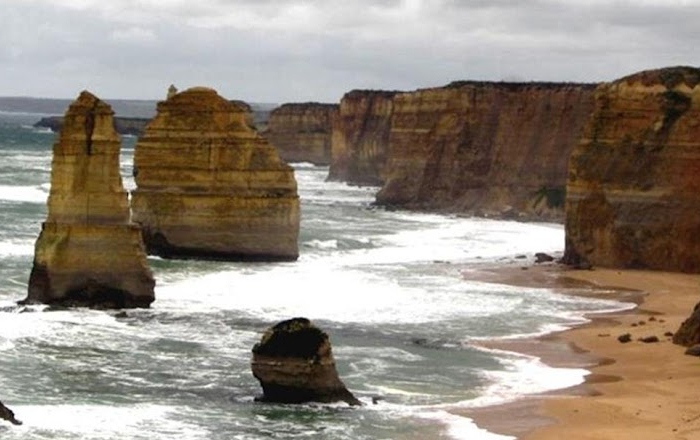
In Australia, I felt a kinship with Aboriginal people, who had also been marginalized in ways that reminded me of Black and Indigenous struggles in the United States. That was who I felt solidarity with on the other side of the world.
Walking down a street in Cairns, an Aboriginal man approached me. Brown skin, wide nose, hair almost in an afro.
“Teresa?” he said.
“No,” I told him. “I’m not Teresa.”
It made me smile though. At the end of an around-the-world trip, on the other side of the planet, being recognized so far from home, even by mistake, felt delightful.
Coming Home to the Question
Advertisement
As a Black woman moving across the world for nearly two decades, I have been sister and stranger, spectacle and ghost, guest, insider, and outsider, sometimes in the same day. How people responded to me depended on their country, their particular history, their proximity to Blackness, or their ignorance of it.
There were always painful moments of reckoning when people asked where I was from. I’d say the United States. They’d ask again. No, where is your family from? Where are your people from? And I would have to explain the transatlantic slave trade, about what was stolen. Those were always heavy moments. I live inside that history. Making it concrete for strangers was never easy.
I met a gracious Kenyan woman who also asked me where I was from. When I answered, she put her arm next to mine. Admiring our similar skin tones, she said, “We are sisters, you and I. Welcome home.”
She embraced me, and though I do not have any Kenyan ancestral connection, in that moment I felt both the closeness and the distance, the weight of history and the beauty of belonging. A familiar guest. A distant cousin finally returned. Kenya gave me something I didn’t know I needed.
Even now, I think back to that boy in Kenya. I am indeed Black like him. But I am also very different. That tension, between belonging and not belonging, between sister and stranger, was something I had to embrace and reckon with at every turn.
Yet it was moments like the Kenyan classroom, the coffee shop in Senegal, and the Babalawo in Cuba blessing me at the altar, that kept me going. Not because they made up for the rough moments or the reckoning. They didn’t. But they were balm. Enough to take me around the world and bring me back home.