Hip-hop history often remembers the records but overlooks the people and relationships behind them. Digital Underground was more than hit songs and unforgettable characters. The group brought together diverse musical influences, personalities, and experiences. Together, they helped push West Coast hip-hop in new directions. At the center was Shock G, whose imagination shaped the group’s identity. Alongside him, Money B helped bring that vision to life while building a legacy of his own.
Born Ronald Brooks in Philadelphia and raised in Oakland, Money B’s perspective was shaped long before the music business came calling. Growing up around the Black Panther Party, attending a community-centered school, and finding his footing in a Bay Area culture that valued independence and self-expression all helped shape the artist and the man. His path into Digital Underground began through his partnership with DJ Fuze and their group Raw Fusion, but what followed became part of a much larger hip-hop story.
From the musical chemistry that fueled classics like “The Humpty Dance,” “Freaks of the Industry,” and “Same Song” to the group’s connection with a young Tupac Shakur, Money B witnessed history from inside the room.
He saw Shock G work, learned from his musical instincts, and experienced the creative freedom that made Digital Underground so distinctive. He also understands that the story extends beyond the records: it includes the people who helped build the movement, the lives that continued after the spotlight shifted, and the responsibility of making sure those contributions are remembered.
Today, Money B remains active onstage and in the studio, bringing the Digital Underground spirit into new music, collaborations, and fresh ways of connecting with fans. His memoir, A D.U. Party Don’t Stop: The Money B Story, reaches beyond celebrity and backstage memories to explore the world that shaped him—from the Black Panther Party era and the crack epidemic to the rise of Digital Underground, Tupac’s emergence, and the realities of finding your footing after early fame. He is also embracing new technology without abandoning the tangible connection that physical music products once offered.
This is a conversation about the making of Digital Underground, the genius of Shock G, the culture that surrounded them, and the responsibility of telling your own story before somebody else tells it for you. Money B reflects on the experiences that shaped his life, the legacy he continues to represent, and why staying true to yourself matters more than chasing the next trend. The history is real, the funk is still moving, and the story is far from finished.
Parlé Mag: You grew up in an environment shaped by the Black Panther Party, community responsibility, and the Oakland Community Learning Center. What lessons from that period stayed with you as you moved from childhood into the music business?
Money B: My parents were in the Black Panther Party, and I was raised in and around that environment. I attended the Oakland Community Learning Center, or Oakland Community School, which was founded by Huey P. Newton and the Black Panther Party.
Just attending that school and being raised in that environment taught me that I was raised by the village. It was always about what was best for the collective. On top of that, we were taught how to learn, not necessarily what to learn. We were encouraged to ask questions, be inquisitive, do our own research, find out for ourselves, and never be afraid to question anything.
I think all of that played a role in the human being and artist I became, and it influenced how I navigated situations in the music business while growing into adulthood.
Parlé Mag: Before Digital Underground became the group the world came to know, your connection with Shock G and Chopmaster J began through Fuze and the search for a DJ. Take us back to that introduction. How did a meeting intended to bring Fuze into the fold become the beginning of your own place in the DU family?
Money B: It’s well documented that I met Shock G and Chopmaster J through a meeting that happened when they needed a DJ and wanted Fuze to be their DJ. Fuze was renting a room in my mom’s apartment, and we were already a group called Raw Fusion.
Through that meeting, I got to know Shock. Initially, it was because they wanted Fuze, but as we started doing shows together and spending time around each other, I think we developed an appreciation for what each of us could do.
Shock and Jimmy were a little older than me. Fuze and I were more into boom-bap and the hip-hop of the time. Shock was a little more old-school. He came from that late-’70s wave of rappers, but he was heavily into P-Funk. I think the combination of all of us played a role in what we eventually became.
Parlé Mag: Digital Underground brought different generations, hometowns, and musical sensibilities into one creative space. When you look back at that mix—from Fuze’s East Coast hip-hop leanings to Chopmaster J’s jazz connections and Shock G’s P-Funk devotion—what made those differences work rather than pull the group in separate directions?
Money B: We all came from different backgrounds, and that played into what Digital Underground became. It was like a bowl of gumbo, like the song “Oregano Flow.” Everybody threw what they had into the pot.
Even though it was Shock G’s musical vision, we all drew from our experiences and backgrounds. The environment was open to whatever you suggested. If it was dope, it could probably be used.
I think that was a big part of it. Shock was such a huge fan of P-Funk and Parliament, and that music represented a free-thinking, free-form approach, with George Clinton directing the overall vision. Shock G was our George Clinton. We were all doing our thing, and it worked.
I always tell people that Shock was a musical genius. Working with him taught me so much, especially about recording. As a rapper who loved hip-hop, I was used to a familiar structure. My ideal song had an eight-bar intro, 16 bars to rap, an eight-bar hook, and then the pattern repeated.
Shock didn’t approach it that way. I watched him play and sequence a song around whatever he felt. I’d never witnessed that before. His attention to detail during mixing and mastering was incredible. He was a perfectionist who knew exactly what he wanted in the studio and wouldn’t rest until he got it. At the same time, he was open to suggestions.
Watching his creative process taught me a lot. Shock was a deep thinker, kind, and very giving. I think that’s one reason we gravitated toward one another. At the end of the day, most of the members of Digital Underground were—or at least wanted to be—good human beings.
Parlé Mag: Tupac’s time with Digital Underground became an important part of hip-hop history, but none of you could have known exactly how far his journey would take him. What stood out about him when he first came around, and how do you look at your connection to his early development today?
Money B: When we met Tupac, there’s no way anybody could have known he would become the global icon he did. What we did know was that he was talented, driven, had a great work ethic, and was charismatic from the moment you met him.
With all of that, the sky was the limit. We knew he had potential, but I think we all believed we had that same potential. It was great to work within a collective where we felt everybody had the talent to accomplish what they wanted.
Looking back, knowing I was part of that history is a great feeling. It’s something nobody can ever take away from me or us.
At the same time, I don’t take credit for Tupac’s overall success. I believe he had the talent that, wherever he was and whoever he worked with, he eventually would have broken through. He was that talented, driven, and focused.
But that doesn’t take away from the fact that he came through Digital Underground and that we helped nurture what he eventually became. I’m definitely proud of that.
Parlé Mag: Raw Fusion was already your musical home with Fuze before Digital Underground entered the picture, and the group had evolved from MGM, with Goldfingers and Mac Mone in the mix. How did you balance your own ambitions with being part of a larger collective built around Shock G’s vision?
Money B: Fuze and I were Raw Fusion before we even joined Digital Underground. Before that, the group was called MGM, which stood for Money B, Goldfingers—Fuze’s original DJ name—and Mac Mone, my best friend and the other member of Raw Fusion.
We weren’t inspired to do something else. Raw Fusion was the original vision for Fuze, Mac Mone, and me. We just happened to come through Digital Underground.
All of us—Raw Fusion, Tupac, Gold Money, even Chopmaster J to an extent, and Shock G’s other collaborators—had visions of doing our own projects. Joining Digital Underground was more like becoming part of a large production team, with everybody coming together to help Shock with his vision.
As an organization, we knew we all had goals of doing our own projects. The goal for Atron [Gregory], Shock, TNT [Management], and the rest of the team was to help everybody get their own deal. It wasn’t a matter of suddenly deciding to do something different. Fuze and I had always been Raw Fusion.
Parlé Mag: The Bay Area has always had its own relationship with funk, individuality, and doing things on your own terms. Looking at the line from earlier Bay Area music to Digital Underground and, later, the hyphy movement, do you see a shared spirit connecting Humpty Hump’s anything-goes attitude with artists like Mac Dre?
Money B: When you talk about the Bay Area, musically, you can go all the way back to Sly and the Family Stone, the whole thing happening in Haight-Ashbury, Con Funk Shun, Larry Graham, and the funk. It was a vibe. The Bay Area has always been about free thinkers and activism.
Even a song like “Doowutchyalike” reflected that spirit. We do what we like.
As far as influence, I think Mac Dre carried some of the spirit of what Humpty Hump was talking about. “Being wild, shooting an arrow like Cupid,” being fly, dressing how you want—it didn’t matter how you looked or acted. You were cool and unapologetically yourself. Other people’s opinions didn’t matter, and you felt free to do what you wanted.
When you look at Mac Dre and the hyphy movement, I think you can hear an extension of what Humpty Hump—and even Shock G—were trying to communicate. I’m not saying Mac Dre copied the style or took it directly. I’m saying that the spirit carried through a generation or so later.
Coming up in the Bay, it’s just one of those things. It’s in us, not on us. I can’t explain it to somebody who isn’t from here. We just have it like that.
Parlé Mag: You’re still representing Digital Underground through live shows, new music, and the people who remain part of its orbit. How do you honor Shock G’s leadership while also making room for the wider circle of artists and contributors who helped make the group what it was?
Money B: Moving forward, my goal is to carry the Digital Underground legacy properly—not just for Shock G, but also for Cleetis Mack, Schmoovy Schmoov, Saafir, Kenny-K, and everybody else who contributed.
Shock was the one who introduced me to Young Hump. He told me, “Hey, this is the guy who can do it the way you want it done.” He also explained how we would come together and rock as a group.
The current touring version of Digital Underground includes me, Young Hump, and DJ Alwayz. In our shows and in any music I release associated with Digital Underground, I make sure Shock G’s name is never forgotten.
Shock was the visionary, the founder, and the person whose musical vision drove the group. Digital Underground was his baby, and he’s the one we follow. We dedicate a section of our show to Shock and make sure the audience says his name.
I represent the brand, too. I wear the merchandise whenever I get the chance. It’s DU for life.
I also try to represent the remaining members of the crew, including Mystic, Esinchill, Numskull from the Luniz, J-Beats, Pee-Wee, and others, in whatever way I can.
First and foremost, I want to make sure we never forget Shock G, Cleetis Mack, Schmoovy Schmoov, Kenny-K, Saafir, and the others who aren’t here to speak for themselves. I try to be a voice for them and make sure they’ll always be remembered.
Parlé Mag: Your recent single “Dumb Out,” with Young Hump and 4rAx, brings the DU family together over production by The Mekanix.
What connects this record to the spirit of “Doowutchyalike” and “The Humpty Dance,” and what makes The Mekanix such an important part of the Bay Area sound?
Money B: To me, “Dumb Out” is a new Digital Underground song. It features Young Hump, who is part of Digital Underground, and 4rAx, who comes from the Digital Underground collective. In the video, you also see Mystic and Esinchill. That’s the DU family. That song and video represent Digital Underground right now.
“Dumb Out” means to bug out. It’s in the same vein as “The Humpty Dance.” It’s like, just act wild and do what you like. “Dumb Out” and “Doowutchyalike” are saying the same thing.
The production comes from The Mekanix, and to me, they’re the Bay Area sound. If you’re from the Bay and you’ve never gotten a track from The Mekanix or done a song with them, I don’t know if you’ve really been stamped like that.
Everybody I know and respect who has really done it in the Bay has worked with The Mekanix. That’s how important they are to the Bay Area mob-music sound. Put that production together with our energy, and you get “Dumb Out.” It’s cracking like that.
Parlé Mag: On “Underground Business,” you join forces with EPMD’s Parrish Smith over production by DJ Supa Dave. For someone who came up on that late-’80s and ’90s sound, what made this collaboration special, and how does the title connect the EPMD tradition with the kind of hip-hop you want to keep making?
Money B: “Underground Business” is a totally different vibe. It’s a collaboration with one of my hip-hop heroes, Parrish Smith from EPMD—(Erick and) Parrish Making Dollars.
It came about through my man Josh Menza from DCM on Long Island. I was working with them, and I was out there when PMD came through the studio. They played him the track, and for me, it was a bucket-list moment. I never thought I’d record a song with PMD.
We did the track, and it came out dope. Shout-out to DJ Supa Dave, who produced it and did the cuts.
The title is a nod to EPMD’s tradition. If you’re an EPMD fan, you know albums like Strictly Business, Unfinished Business, and Back to Business. We called ours “Underground Business” to connect Digital Underground with hip-hop’s underground roots. It’s about taking the music back to the sewer.
It’s representative of the style of hip-hop we came up under in the late ’80s and ’90s. I’m really proud of that track, and it’s getting a great response because we’re busting bars on that thing. We’re doing underground business. Get with it!
Parlé Mag: Your memoir moves through several defining periods of American and hip-hop history, from growing up around the Black Panther Party to coming of age during the crack epidemic, finding fame with Digital Underground, and building a life beyond it. Why was this the right time to put those experiences on record, and what do you hope readers understand beyond the music-industry stories?
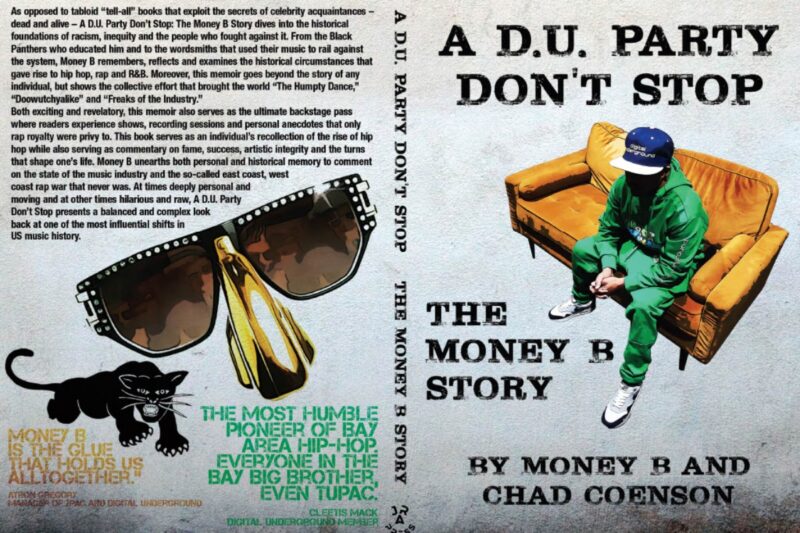 Money B: A D.U. Party Don’t Stop is the Money B story. I take you through my whole experience, starting with growing up in the 1970s around the Black Panther Party, then being a young teenager in the ’80s as the crack-cocaine epidemic hit our communities.
In the ’90s, I navigated that world while being part of Digital Underground and experiencing the rise to fame. But what happens when your fame starts to fade? You’re still a young man, maybe 25 or 26 years old, but you have a family. How do you navigate that?
I take you through that entire experience firsthand. Rather than making it a tell-all story about backstage access in hip-hop, I consider it an American history story. I’m giving you my firsthand experience of what it was like to be a child in the ’70s, an adolescent in the ’80s, and a young adult experiencing fame in the ’90s—and then figuring out what comes next.
I believe all of us need to tell our stories. People ask why now, and my answer is that it’s always time to tell your story. That applies to everybody, not just people in hip-hop.
If we don’t tell our stories, other people will tell them for us. Speaking from where I come from, in the Black and Brown community, it seems that in this climate there’s an effort to erase our accomplishments and diminish our importance.
If we don’t document our experiences, others can mute our contributions or tell the story differently. It’s important that I tell my story, and it’s important that we all document ours so the generations after us can look back, learn, and read about what really happened.
You can get A D.U. Party Don’t Stop: The Money B Story, co-written by Chad Coenson, through the Digital Underground websites, DUMerch.com or DigitalUndergroundT-Shirts.com. You can also get a signed copy from me.
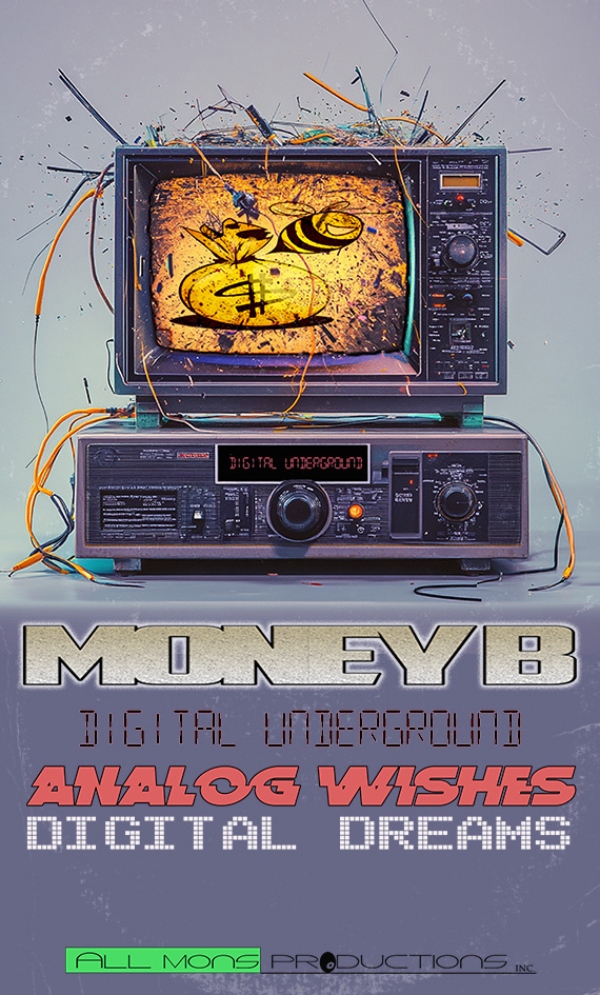 Parlé Mag: You’ve continued to release music and perform while exploring ways technology can bring fans closer to your work. Tell us about Analog Wishes Digital Dreams and the tap-to-play content card. How does the project combine the appeal of something physical with new music, DU history, and direct access to you?
Money B: I’m always trying to push boundaries, adapt to technology, and show younger artists—and legacy artists from my generation—that there’s no reason to stop. If you have something to offer, keep going.
I have the book, these great singles, and a catalog of music I’ll continue releasing that represents Digital Underground. I’m also staying current with technology.
One new project is a tap-to-play content card called Analog Wishes Digital Dreams. It’s a card, similar to a credit card, that you tap against your phone or another device. It opens a standalone platform featuring a full album of new music.
I’m featuring artists including Krayzie Bone from Bone Thugs, Ras Kass, and Guapdad 4000, along with others. The platform also includes visual content about Digital Underground’s history, as well as real-world experiences and access. If you come to the shows, you can get discounts on merchandise and find new ways to support me.
We come from an era of tangible products. We used to buy CDs, cassettes, and vinyl—things we could hold. I think when you can hold something, it resonates differently. You can sit it down, look at it, touch it, and feel it.
With streaming, everything can become about the algorithm. It goes up and down, and then it disappears. You hear something today, and tomorrow you’re looking for the next thing. The music can wither away into the ether.
I’d rather give people something they can hold, feel, and touch. Whatever I release, I’m always going to try to offer a tangible product. Artists can do that in different ways—sell a T-shirt with a code for a free download, release vinyl with a project, or offer a tap-to-play card.
I believe there’s meaning in having something physical that connects you to the music.
Parlé Mag: After everything you’ve experienced, what does moving forward look like for you now? How do you stay open to new music, technology, and younger audiences while remaining true to the Money B people have known and supported for decades?
Money B: I’m always trying to move forward and stay current, but never forget who I am or where I came from.
I’m not trying to compete with younger or newer artists. My goal and my whole existence are about being Money B. If you know Money B and you’ve supported Money B, when you see me, you’re going to say, “Yeah, that’s Money B.” I’m not trying to become some brand-new dude.
If you’ve supported our music, you can still support it now. It doesn’t matter how old you are. This whole ageism thing is a joke to me, and I don’t pay attention to it. I keep doing what I do because I enjoy it and I can.
That’s the Money B story. “Underground Business.” We Dumb Out.” And, of course, A D.U. Party Don’t Stop. That’s just the way the story goes. I’m out.
Get Connected With Money B
Instagram: @moneyb69
Instagram: @digitalundergroundofficial