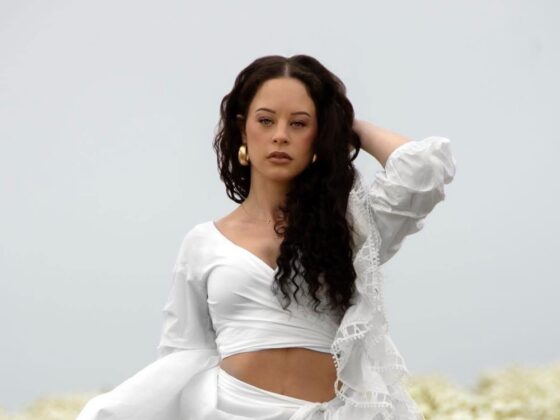
Nao Yoshioka doesn’t sound like someone who “studied soul”—she sounds like someone who chased it until it had no choice but to answer back.
Born in Japan, she didn’t inherit the genre’s history, so she learned it the only way that works: by obsession. Voice after voice. Record after record. Until emotion started to matter more than geography.
Then Sam Cooke hit differently. Not inspiration—alignment. Like hearing something she’d been trying to say without knowing the shape of it yet. That pull is what eventually pushed her to New York alone, into rooms where the music doesn’t translate and doesn’t forgive anything fake.
What came out the other side isn’t imitation—it’s pressure made audible. A voice that holds back just enough to make the release hit harder. Controlled, but never safe.
Now that same tension shows up in “Shadow,” her track with Bilal. Inspired by Carl Jung’s idea of the hidden self, it plays like two voices circling the same uncomfortable truth: you don’t get rid of your darkness—you learn to sit next to it.
Bilal bends the edges. Nao holds the center. Nothing resolves cleanly, and that’s the point.
She’s not presenting a transformation here. She’s standing inside one.
Parlé Mag: When you stopped trying to “fix” your flaws and started sitting with them, what changed in your voice — not technically, but emotionally?
Nao: Until I released this album, I think I spent a long time believing that if I could become a “better” version of myself, my life would feel richer, and maybe I could finally escape my loneliness and inner conflict.
Because of that, I was always drawn toward expressions that didn’t feel like “me” — things that didn’t naturally come from within me. Those kinds of expressions excited me more. Honestly, that mindset helped me grow in many ways. It changed me for the better.
But at the same time, I think I became addicted to growth itself. Constantly trying to evolve started to feel unnatural, and eventually I hit a wall.
When I finally started facing myself honestly, my musical choices changed too. Instead of trying to become something else, I started accepting the way my voice naturally wanted to come out.
Once I did that, people started telling me, “This really sounds like Nao Yoshioka.” I think this album became a much more natural expression of who I really am, without trying to reach for something outside of myself.
Parlé Mag: This idea of the “Shadow” from Carl Jung — did it feel like a discovery, or something you always knew but didn’t yet have the language for?
Nao: I discovered Jung’s idea of the “Shadow” after finishing my previous album and touring across 11 countries.
At that time, I suddenly felt like I had returned to the very beginning of my life — almost like becoming an elementary school kid again, standing in front of a completely new world. Everything felt incredibly open, like all I could see was possibility.
I felt like I was starting my life over again in the best possible way, and I kept asking myself, “What is this feeling?”
That was when I came across Carl Jung’s concept of the “Self.” I read that, in order to reach the Self, you have to embrace your Shadow.
When I read that, everything connected for me. I realized the things I had been naturally doing over the past few years were actually part of integrating my Shadow and my Self.
So for me, it wasn’t really a new discovery. It felt more like something I had always known deep inside finally being given a name.
Parlé Mag: “Shadow” doesn’t feel like a performance — it feels like a conversation with yourself. Were there parts of this song that were difficult to admit out loud?
Nao: “Shadow” really is a conversation with myself.
In this song, I’m singing from the side of the shadow, while Bilal represents the light.
The hardest thing for me to admit was that I was weak — that there were painful parts of myself I had spent a long time avoiding.
For years, I believed that if I could become better, stronger, more evolved, then eventually I’d be able to fully love myself. So putting these feelings into words this honestly was something very new for me.
I used to think I had to earn self-acceptance through effort. While I still believe growth is beautiful, I also realized I had spent a very long time unable to accept the version of myself that was simply vulnerable.
Writing this song made me want to finally tell those parts of myself, “You’re allowed to exist too.”
Parlé Mag: Moving from Flow into Self, what did you have to leave behind creatively to access this level of honesty?
Nao: Whenever I make an album, it feels like I’m writing a letter to myself two or three years into the future.
I always want to create songs that the future version of me can still sing while continuing to move forward in life.
With Flow, one of my intentions was actually to avoid writing songs that felt too sad or painful. But with Self, I decided to let go of that limitation.
I stopped telling myself that I always had to sound hopeful or emotionally strong. Instead, I tried to simply write whatever naturally came out of me.
Letting go of that internal restriction was necessary for me to reach this level of honesty.
 Parlé Mag: Your tone carries weight without force — did that come from discipline, or from life experiences unfolding in real time?
Nao: There was definitely a time in my life when becoming someone else through music felt comforting to me.
Singing allowed me to escape the version of myself I didn’t like, and in some ways I think I was trying to love myself by becoming someone else.
But now, after 14 years since my debut — after sharing my voice with people around the world — little by little, I’ve started learning how to truly love myself.
I think that journey is finally showing up in my voice.
Of course, there were phases where I focused too much on technique. There were times when I became overly influenced by vocal directions that weren’t natural to me, or moments when I thought singing higher notes was the answer.
Now, all of those experiences feel fully digested inside me. They’ve become part of a newer and more honest expression.
Honestly, I feel like I’m in a really beautiful place as an artist right now.
Parlé Mag: When you first connected with Bilal on this record, did it feel like a collaboration, or like two sides of the same idea coming together?
Nao: I had already felt a strange sense of connection with Bilal for a long time.
Many of the musicians he works with are people I’ve also performed with. Whenever he came to Japan, I would go see his shows, and sometimes we ended up at the same festivals in the U.S.
So it already felt like our paths had been crossing for years.
But through this collaboration, I truly felt that he elevated this song into another dimension.
There’s a section in the bridge where the harmonies expand almost like a spell, and that was completely his idea during the recording session. We layered the vocals together, and suddenly it became something heavenly while still feeling deeply grounded and emotional.
I honestly don’t think this song could have reached this level without him, and I’m deeply grateful for what he brought into it.
Parlé Mag: You’ve performed on major stages like the Apollo Theater — does a song like this feel bigger than any stage you’ve stood on?
Nao: This song feels like a cry from my soul.
So I don’t know if I would say it feels “bigger” than those stages, but I do feel like it belongs in a place like the Apollo Theater.
The Apollo is such a historic space where so many performances have deeply moved people across generations. To me, it almost feels like a sacred stage.
If I could sing “Shadow” there one day, I think that would truly feel like one of my dreams coming true.
Parlé Mag: “In The Rain” felt like release, while “Shadow” feels like confrontation. Was that emotional progression intentional?
Nao: That’s actually such an interesting perspective, and when I heard that, I really felt it was true.
With Flow, I was learning to stop forcing myself to change and instead allowing myself to simply be who I really am.
With Self, I think I moved into confronting the weaker parts of myself.
So if “In The Rain” feels like release, then maybe “Shadow” really is confrontation. That emotional progression is actually at the core of this album.
“Shadow” especially carries one of the central messages of Self. It’s about facing the parts of yourself you most wanted to avoid, and then becoming whole by merging with them instead of rejecting them.
That was one of the most important emotional stories I wanted this album to tell.
Parlé Mag: Coming from Japan into the lineage of soul music, did you feel the need to prove your connection to it, or did you simply live in it until it became natural?
Nao: In the beginning, I definitely felt like I had to prove how deeply this music had influenced me.
If people only heard my music without seeing me, it often felt naturally accepted. But the moment people saw my face — saw that I was Asian and Japanese — suddenly there were questions.
People would wonder why I was singing soul music or where that inspiration came from.
In interviews, I often spoke about how soul music saved me. I shared how deeply I loved it and how much it inspired me.
Recently, more people have started to feel the sincerity and dedication behind my journey over the years.
Because of that, I feel the meaning of continuing to sing more strongly than ever.
Parlé Mag: When you listen back to “Shadow,” do you hear peace, or tension still working itself out?
Nao: When I listen back to “Shadow,” what I feel isn’t peace or tension — it’s liberation.
In the verses and choruses, it still feels like I’m having a conversation with myself, searching for answers.
But once the song reaches the bridge, the energy completely changes. At that point, what I feel is release and purification.
So to me, this song isn’t only about pain or struggle. It’s about the moment you finally free yourself by facing who you really are.
Parlé Mag: Has embracing your Shadow made your writing freer, or simply more honest about its limits?
Nao: I don’t think it made me “freer,” and I don’t think it simply made me more honest about my limits either.
It feels more like finally recognizing something that had always existed inside me. Not discovering something new, but finally allowing myself to see what was already there.
Now I often feel a limitless possibility inside myself. It’s hard to explain, like a universe expanding within my heart.
Ironically, when I was fighting my Shadow or trying to reject it, that’s when I felt most limited.
Back then, I was always trying to push my limits further and further. But after embracing my Shadow, those limits themselves started disappearing.
Now I feel a kind of endless possibility instead.
Parlé Mag: When Self is fully released, what do you hope people understand about you that they couldn’t see before?
Nao: With Self, I’m not trying to say, “These are my emotions — please understand me.” It’s not really about wanting people to know me more deeply either.
More than anything, I hope that through my experiences, listeners can reconnect with their own emotions and inner worlds. I’ve always felt that the most personal experiences are often the ones that connect most deeply with other people.
It’s not only universally understandable emotions that bring people together. Sometimes the feelings you think nobody else could possibly understand are actually the ones that resonate the furthest.
I’ve had many moments where I sang emotions I thought only I carried. Then people from countries I never expected told me, “I’ve felt that too.”
If this album can help someone forgive themselves or look inward more honestly, that would mean everything to me.
Stay Connected with Nao Yoshioka
Official Website: naoyoshika.com
Instagram: @nao_yoshioka
Music:
Album: Self (out July 17)
Album: Flow
Live:
NY Show — May 29 at Nublu